
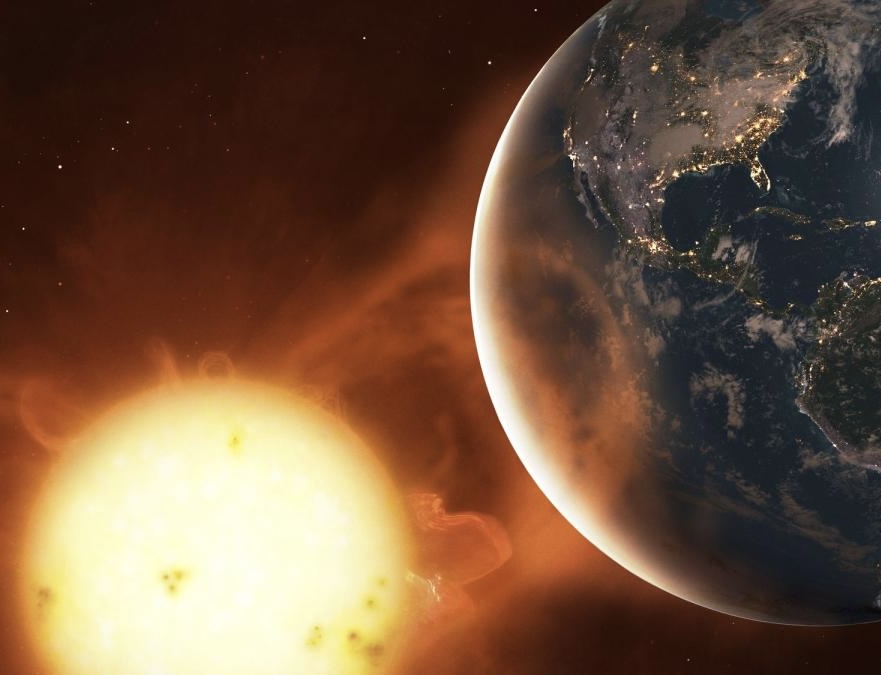
A solar storm has been underway on Earth since the evening of Friday 10 May, but the most intense effects are expected on Saturday 11 May.
The US agency’s Space Weather Prediction Center, Noaaraised the storm forecast level to that G4, the second highest on the ladder.
What will the consequences be? The G4 level includes some impacts on the electricity gridsui satellite navigation systems such as GPS and problems a satellites and spacecraftas well as a greater probability of being able to admire the Northern Lightseven at low latitudes.
We interviewed the professor on the topic Mauro Messerottiteacher of Space Meteorology at Department of Physics of the University of Trieste and senior research associate atINAF-Astronomical Observatory of Trieste.
WHAT IS A SOLAR STORM?
The term “solar storm” refers to it a series of energetic disturbances, which originate in solar active regions. The latter are made up of groups of sunspots, visible in the Photosphere, which are home to very intense magnetic fields of opposite polarities. An active Region is therefore a reservoir of enormous quantities of magnetic energy, but it is not stable and can release it impulsively.
The release phenomenon is called “solar flare”, because the transformation of magnetic energy into kinetic energy causes a strong localized heating of the atmospheric plasma solar energy up to tens of millions of absolute degrees, which is observed as flashes of electromagnetic radiation (photons) from gamma rays to radio waves, acceleration of electrons and protons at very high speeds and, often but not always, the acceleration of bubbles of magnetized plasma (CME, mass ejections from the solar Corona) towards the Earth or in other directions. This range of perturbative phenomena is called “solar storm” and each of them carries energy, which it transmits to the physical systems with which it interacts.
WHAT CONSEQUENCES COULD IT HAVE? IS THERE AN INTENSITY SCALE LIKE THOSE, FOR EXAMPLE, OF EARTHQUAKES AND TORNADOS?
X-rays and UV rays transfer energy to the Earth’s Thermosphere and Mesosphere, contributing to their thermodynamics. They also increase the degree of ionization of the plasma of the Earth’s ionosphere, increasing its turbulence and modifying the propagation, absorption and reflection of radio signals. The energetic solar electrons and protons, which manage to penetrate the shield represented by the geomagnetic field, have an impact on technological and biological systems in space.
For example, increase the aging rate of solar panels, ““deceive” the orientation sensors generating spurious signals that are interpreted as real by the orientation control electronics, they give rise to the accumulation of electric charge on the surface of space systems, which can penetrate inside and cause temporary or permanent malfunctions, even single particles hitting active electronic circuits can cause malfunctions. A high flux of energetic particles constitutes a dose of ionizing radiation which can represent a danger to the physiology of astronauts. Similarly it happens for the crews and passengers of aircraft on polar routes, more subject to the flow of ionizing radiation of solar origin.
Furthermore, in conjunction with the most intense phenomena there may be an interruption in the propagation of short waves, used by aircraft to communicate with control centres, and the impossibility of receiving radio signals from GPS satellites, used for geolocalisation during take-off and landing.
When these risks exist, airlines divert aircraft to other non-polar routes or block their take-off. The increased flow of electrons gives rise to intense electric currents in the Ionosphere, which can be captured by induction from long electrical conductors. Electricity interruptions can therefore occur which can last for many hours and increases the probability that pipelines, even underwater, will suffer electrogalvanic perforations. When a CME arrives near the Earth, it compresses the geomagnetic field, transfers energy to it and the resulting disturbance is called a geomagnetic storm. If conditions of opposite magnetic polarity exist between the CME field and the Earth’s, energetic particles can penetrate the magnetic shield and enter the Magnetosphere. This enhances the Aurora Polaris, the weak fluorescence phenomena that are observed in the night sky usually at high latitudes, where atoms and molecules of the atmosphere acquire energy from the interaction with particles of solar origin and when they de-energize they emit photons of colored light at wavelengths which depend on the atomic and molecular species excited. When the disturbance of solar origin is particularly intense, the interaction regions, which are two oval-shaped ribbons centered on the Earth’s magnetic poles, can widen greatly, even up to the Equator in extreme cases. In these cases, the Auroras will also be visible at much lower latitudes.A very important impact nowadays is that relating to the disturbance of the reception of GPS satellite signals, which can be compromised partially and for a short time or interrupted for even long periods. In this case All applications that rely on geolocation are affected.
There is no intensity scale for “solar storms”. Usually we refer to the intensity of the solar flares that caused them. This is measured in space with the GOES satellites and represents the emission peak in “soft” (= less energetic) X-rays. Three energy classes have been conventionally defined for soft X-ray flares: class C, class M and class X, in order of increasing peak energy..
The Space Weather Prediction Center (SWPC) of NOAA (USA) has developed three semi-empirical scales to quantify the intensity of disturbances and their impacts on technological and biological systems). Each scale is divided into 5 levels, where level 1 represents the minor disturbance with limited impacts and level 5 the extreme disturbance with catastrophic impacts. There are therefore: 1. the scala Rwhich refers to theimportance of jamming and interruption of radio communications; 2. the scala Swhich refers to fluency ed all’maximum energy of energetic particles (Particle Storm); 3. the
scala Gwhich refers to theintensity of the disturbance of the geomagnetic field (Geomagnetic storm).
WHAT LEVEL IS THE INCOMING SOLAR STORM? WHEN WILL THE CLOU BE THERE AND WHAT COULD THE EFFECTS BE IN ITALY?
An active Region, AR 3664, very large and complex, has given rise in recent days to a large series of M-class and X-class X-ray flares and therefore very energetic. Together with other active Regions, 5 CMEs have been accelerated towards the Earth, which will interact with the Earth’s Magnetosphere between Friday 10 May 2024, and Sunday 12 May 2024significantly disturbing the geomagnetic field.
NOAA’s SWPC predicts the occurrence of a severe G4-class geomagnetic storm.Italy is located at intermediate latitudes and therefore on average suffers less from the impacts of not too intense disturbance phenomena. But in this case we could expect significant disturbances in radio communications and GPS signal reception as well as the vision of auroral phenomena.
#Weather #Strong #Solar #Storm #arriving #Earth #problems #telephones #GPS #expert #speaks


/img-s3.ilcdn.fi/448e479e6e21c45e993d8f1fd28c63760e4797dcdd768b5639be2a7ff1d881ba.png "In the Finns’ favorite destination, everyone will soon be devouring grapes – This is what it’s all about")
