Since this Sunday, many French regions undoubtedly have their eyes riveted on the Provencal rail, and in particular the line which links Marseille to Nice. Because almost 10 years after the first – stormy – debates – on the opening to the competition of the rail desired by the European Union, in Provence -Alpes -Côte d’Azur, the South region, the first to try the adventure, welcomes the first trains in the colors of Transdev, on this second lot called to escape the historic monopoly of the SNCF.
The first had been won by a subsidiary of the Public Company, SNCF Sud Azur, which has been operating since mid-December between the arcs and Tende. But the Marseille/Nice line, a “fast” TER, which only stops in nine stations (Marseille St-Charles, Toulon, Carnoules, Les Arcs, Saint-Raphaël, Cannes, Antibes, Nice Saint-Augustin and Nice Ville), is emblematic.
Three million travelers would have borrowed it in 2024 according to the community. The offer will be doubled there, or 14 daily round trips and up to 16 on weekends, With a reliability rate of 97%, promises the call for tenders, Transdev. All without additional cost for the region, recalls its president Renaud Muselier who announced the decline, to Coming from July 1, 20% of the subscription price of all TERs.
“Between Marseille and Toulon we go from 138 to 111 euros, between Cannes and Nice, from 75 to 60 euros, between Nice and Monaco from 46 to 37 euros”, Underlines the elected official while the new trains are announced at the station, with a capacity of 400 places each, 50 of which are in first class. This train will drive at 200km/h at point, for a total of three hours. He is especially a pioneer of a new model for managing a rail line, already tested across the Rhine where Transdev is very established. If the results are there, as much to say that the opening to the competition, which has already moved the lines, in particular to the SNCF, will experience an accelerator on the scale of France. In Provence-Alpes-Côte d’Azur, it is already underway: a third lot is currently the subject of a call for candidates (whose offers have already been received), which concerns the lines of the Alps and Marseille/Les Arcs.
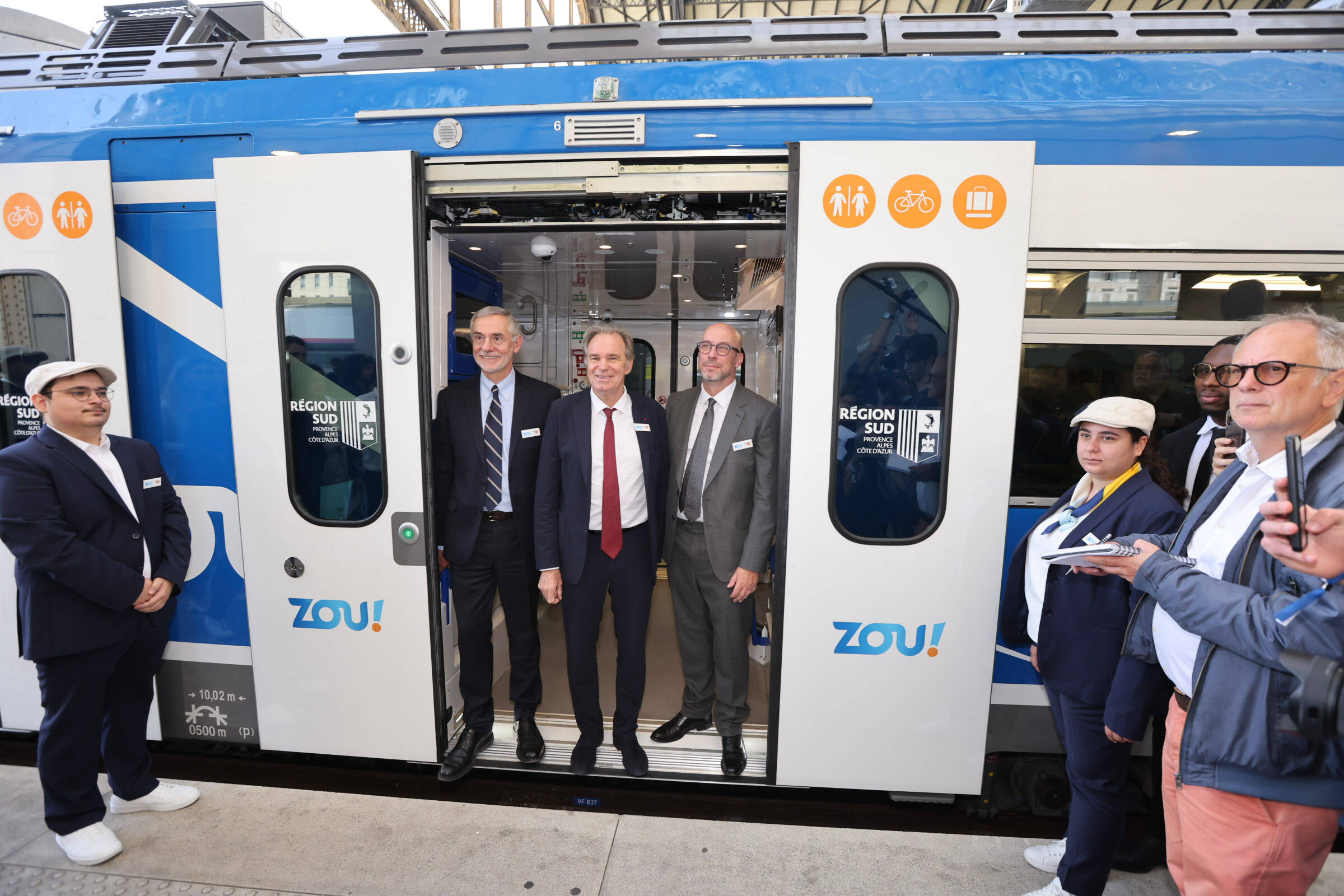
First official registration of the Alstom Omneo Zou trainsets of the Transdev group on the Marseille – Toulon – Nice line following the opening of rail transport. Photo Camille Dodet Camille Dodet / Nice morning.
The interview with Renaud Muselier, Thierry Mallet, and Frédéric Wiscart, Presidents of the Region, Transdev and Alstom France
What do you expect from this change of operator?
Renaud Muselier: The challenge is to realize that there is no possibility of putting more cars on the roads and we have the obligation to develop our rail. By 2030 we must attend a rail revolution in the region. There are European rules transmitted in French law which give the possibility of making a call to the competition in which two lots have been put in place. We are the first to do it because we had the worst service in France: 20% late trains, 11% canceled, 20% fraud and 100 days of strike. After the call for expressions of interest, we realized that six to seven European companies were able to come, we used the experience of European neighbors, whether the English, bad example or the Spanish and Germans, rather better examples, and we made a call for projects on the two largest lines. One was won by a subsidiary of the SNCF and the other by Transdev which responded to a specifications providing 97% of regularity of the trains, in a lined offer with a new maintenance site in Nice and the means dedicated to safety multiplied by 2.5 as well as 16 better equipped trains. This has no additional cost for the community.
How would you define the Transdev method?
Thierry Mallet: Transdev has become a rail operator since 1998 with the opening to competition in Germany where we today exploit the equivalent of a third of all TERs in France outside the Paris region. Then we went to Sweden, to the Netherlands in New Zealand … The rail is a billion euros per year for Transdev. And we adapt the model developed in Germany to France, we will double the service with 210 people where the SNCF operated this line with 170 people. We will have new trains, which allows more reliability. A dedicated deposit, which is a very important element because we completely master the chain between maintenance and exploitation, which is critical in our eyes. All over the world where we are exploiting, we always have a dedicated warehouse, which does not necessarily cost a fortune but which allows you to work in integrated and not in subcontracting on maintenance and moreover Alstom advises us. Finally, the third element, the lines previously were completely integrated into the SNCF model as a whole, there were few dedicated people, moreover in this lot there is no transfer of compulsory staff because no railroad worker was mobilized at more than 50% on this line, while in our model the teams are dedicated to 100% and the boss of the line is on site and is the interlocutor of the region.
Is it an important factor?
Frédéric Wiscart: For us, it is one of the secrets to have people completely dedicated to the line that in the evening can debrief if there have been problems. It is continuous improvement to reach 97% that may not have from the first day, but the goal is to make continuous improvement. Very few people came from the SNCF, only thirty, at volunteering and we completed by recruiting 180 people. They are also much more versatile teams. Maintenance people will also be able to drive trains, we also think about having bus drivers who tomorrow can be part -time train drivers and as soon as a position is released, full time not to miss drivers. We have lots of flexibility elements that do not necessarily exist at the SNCF. And the advantage of opening up to competition is that this will also allow the historic operator to change its model like Deutsche Bahn in Germany where there are three times more offers than in France thanks to the opening to competition.
What will be your relationship with SNCF Réseau?
TM: We have a daily dialogue, almost hour by hour. Our goal is to be every day next to them and to challenge them to ensure for example that if there are delays we remain a priority, that we do not pass behind a TGV or another train. There are a lot of issues, we are never immune to an external event and there is a real -time information issue of travelers on board both on our trains and on the whole Zou network because many people have correspondence.
RM: We must remember that we pay a toll to SNCF Réseau and that the region pays 80 million euros to SNCF Réseau for maintenance. For all this to work, there is in contracts between 10,000 and 100,000 euros in penalties per day so that in the face of the objectives set on know what does what. Unlike the past where when the train was late we didn’t know why or because of whom. And the traveler never had an interest in taking the train which was either absent or on strike or broken down and without any information to customers. There we put each one in their function in place. It’s 97%, if you are below I penalize you, for the rest the ventilation will be made!
What do these new oars change?
FW: Trains have been adapted to meet the needs of the line and users. In terms of outdoor design, we worked with three schools in the region, Toulon, Marseille and Cagnes. In terms of performance we are based on the existing Omneo range and we have already delivered 400 trains technically similar to various regions of France so we were able to integrate all the experience feedback observed elsewhere. For example, energy recovery technologies to braking, new aerodynamics, innovations on the traction chain, and all this put end to end allows us to offer a train whose electricity consumption is 15% lower than that of the previous generation.
RM: Inside, there are food distributors for example, cameras, security officers, bicycle parking … that has nothing to do with the 45 -year -old coral that was riding before. It’s like the minitel and the internet.
The delay in delivery of trains will not have an impact?
FW: In October we announced a delay compared to the initial plan because the OMNEO range, it is hundreds of trains produced over several years so we have undergone the buttresses of different crises, some ruptures on the supply chains. We were still able to deliver 8 trains in mid-June in accordance with the commitment made in October 2024. Three additional trains are being delivery and should arrive second half of July at the latest and the last 5 in the next fall.
TM: In order to be able to offer from the start the 14 round trips we have rented trains to other French regions, some of which are OMNEO, from aura and center Val de Loire, otherwise they will be regiolis of Grand Est. As soon as we receive our new OMNEOs, we will withdraw the rented trains. All are better than corals, even if everyone will not have the Omneo experience from the start, the main thing is the 14 round trips.
And the Marseille/Briançon line?
RM: In the State/Region Plan contract I put a clause saying: Be careful there will be a review if you have the Olympic Games. I had them and this extension will allow us to understand how we could put 3h40 on this journey before and more than 5 hours today. She had been abandoned and there we will have two round trips per day of 3:40 am.