Main climate events of the year 1895 : Cold wave, avalanche, heat wave
From January 1 to 11, 1895: Small cold wave with frequent snowfall in the plain (but a priori no large quantities).
Southern storm And important redoux between January 14 and 15, 1895
From January 22, 1895the cold air resumes the upper hand and becomes quite i, te, se at the end of January 1895 and the temperatures descended at -23 ° C to Nancy, -27 ° C in Langres, -30 ° C in the Vosges. On January 31, 1895, he made -3 ° C in Nice, -8 ° C in Toulon, -10 ° C in Marseille, -11 ° C to this. In Paris, he made up to -13 ° C on January 28.
According to the writings of the time, almost all the rivers in France were frozen at the end of the month.
The intense cold advection of January 31, 1895
The cold wave of February 1895 (Story on the cold wave of winter 1895 and February 1895 >>): the month of February 1895 is the driest and coldest since that of the year 1740. In Paris, the average temperature is – 4 ° 2, a deficit of more than 8 °. The Seine is completely frozen between February 10 and 24 (one of the latest dates ever recorded). For example, the temperature drops to – 15 ° in Nantes, – 15 ° 5 in Paris, – 18 ° in Calvados and – 23 ° near Orleans.

Cold wave February 1895: La Loire jelly in Sully in February 1895

Cold wave February 1895: In Rouen, we cross the Seine frozen on foot in February 1895

Cold wave February 1895: Banquise at the Pont de Sully-sur-Seine in February 1895

Cold wave of February 1895 – Fontaine frozen, place du Châtelet (Paris)

Cold wave of February 1895 – Fontaine frozen, in the gardens of Luxembourg (Paris)

Cold wave of February 1895 – Fontaine frozen, Place de la Concorde (Paris)

Cold wave of February 1895 – Fontaine frozen, place St -Michel (Paris)

February 1895 cold wave – Snow in Paris

February 1895: At the same time, an avalanche in part, the Barèges station (Hautes-Pyrénées).

February 1895: roof swept over 40 meters by the breath of the avalanche d’Orlu
April 27, 1895the Bouzey dam (Vosges), built on a porous sandstone, yields and causes damage to Nomexy. It was a real disaster, causing the direct death of 88 people, and 200 people in total, especially because of the shortage of drinking water during the following weeks in the surrounding villages. It was a sudden break, but which had been preceded by the appearance of significant cracks and deformations. She completely razed downstream buildings. During the 1895 disaster, the tank only contained a third of the current average volume.


Bouzey’s engulfment (Vosges): the Bouzey disaster (88), when the dam yielded, April 27, 1895
From May 16 to 19, 1895
An abnormally cold weather causes snow-beaten in the northeast regions.
Very marked heat wave and drought in September 1895
The exceptionally late heat of September 1895 : September 1895 is the hottest and driest in the history of weather readings. Drought is absolute all over France except in the southwest. Between September 2 and 9, the temperature reached 37 ° in Auxerre, 36 ° in Rennes and Limoges, 35 ° 5 in Paris Saint Maur (absolute record) and 36.2 ° C in Paris-Montsouris, 35 ° in Orléans and 31 ° in Brest. In Paris Saint Maur, the previous record dates from September 1839 where he had made 31.9 ° C.
No drop of rain is observed in Paris from August 14 to October 1. In Toulouse, the rainless period extends from August 8 to September 29. It takes back to October 1752 to find such a dry month.
Back on the heat wave of September 1895 >>

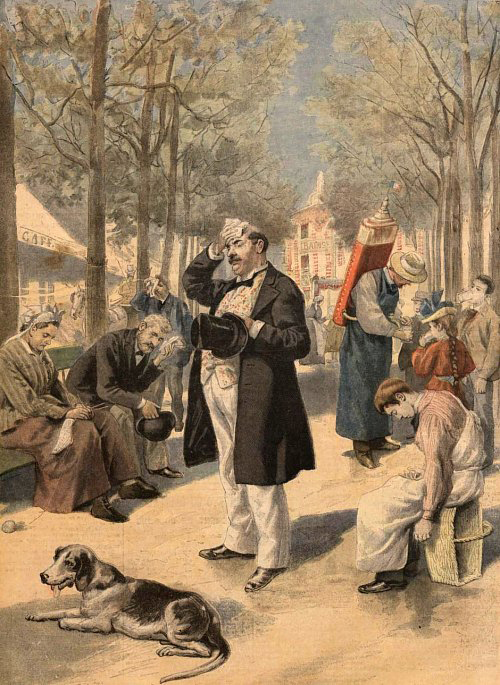
The heat wave of September 1895 in Paris – Le Petit Journal

The heat wave of September 1895 in Paris – Le Monde Illustrated
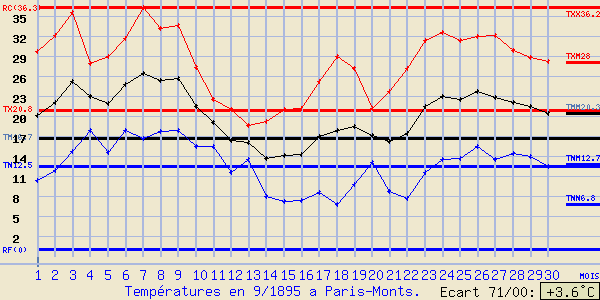
Daily evolution of temperatures in Paris in September 1895 compared to the “normal” of the time. Source: Climate weather
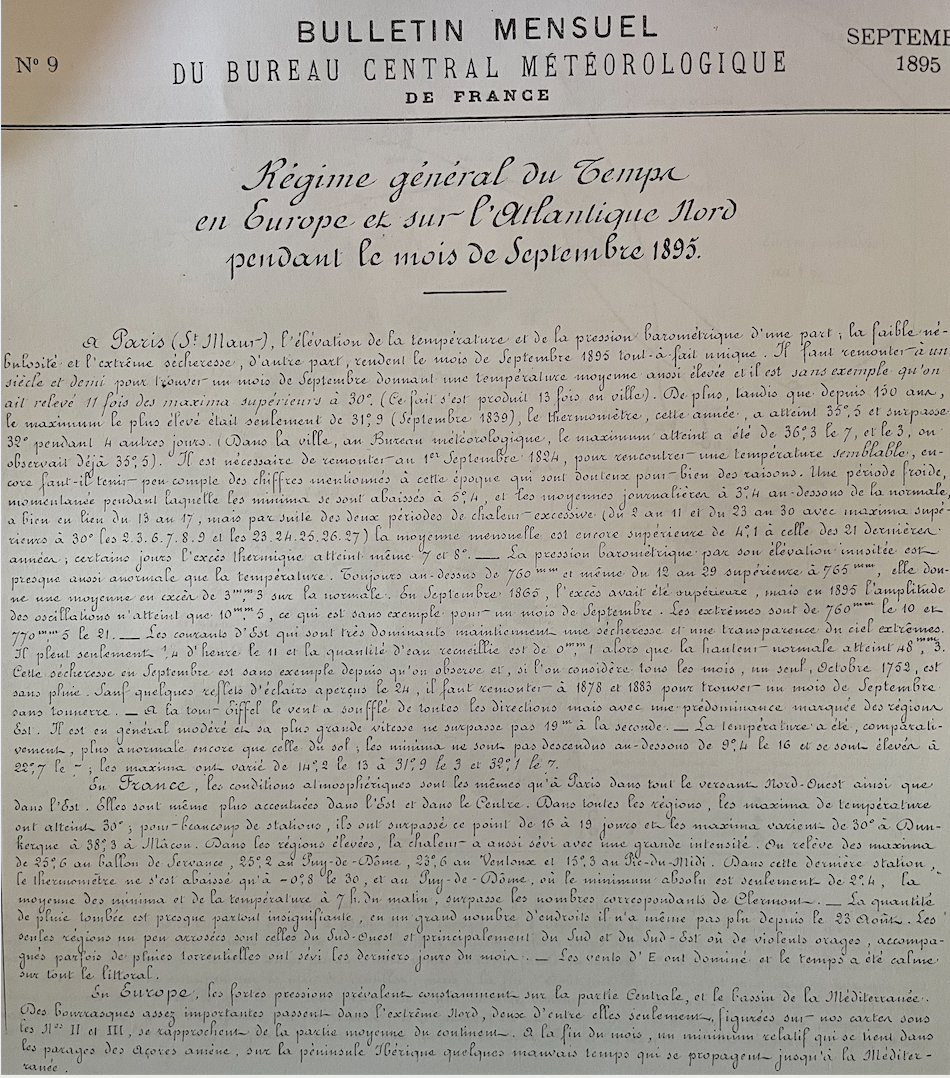
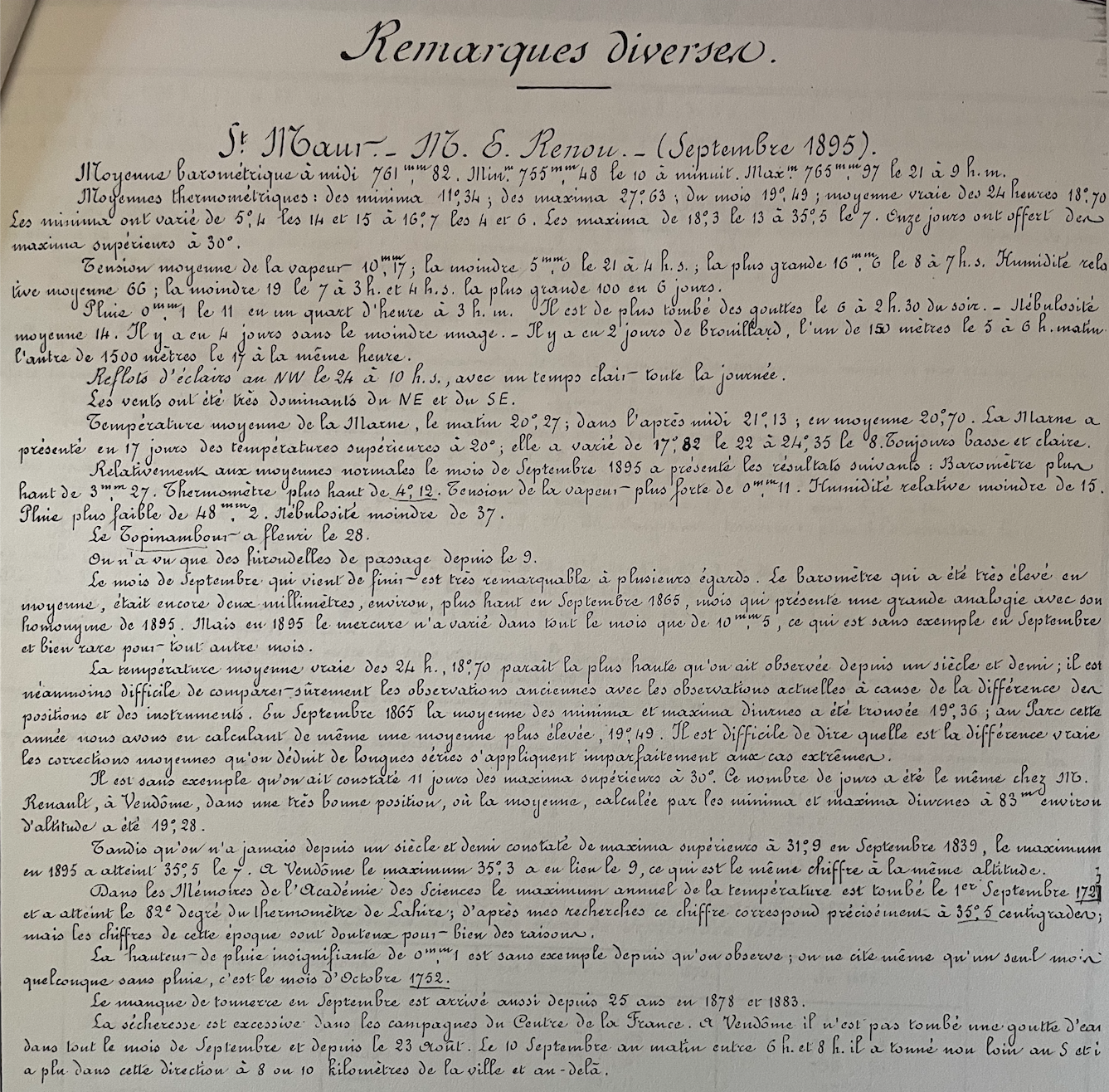
Comment from the monthly bulletin of the central meteorological office in France for September 1895